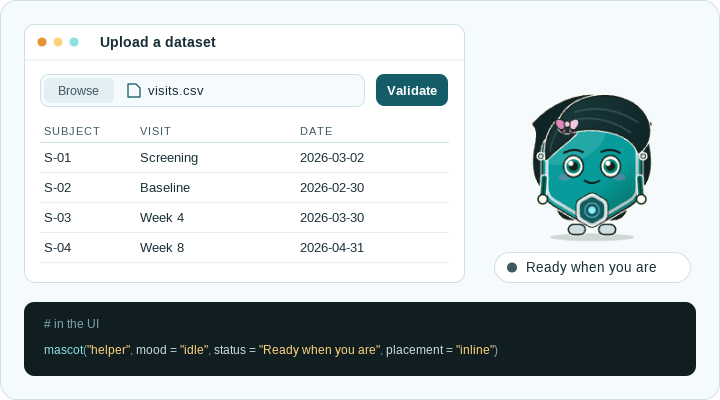
mascot is on CRAN: live, mood-driven mascots for Shiny and Quarto
The mascot package is now on CRAN: add mood-driven characters to Shiny apps and Quarto pages, with visible status text, speech bubbles, click menus and reduced-motion support.
From R development to R engineering
Foundations: fourteen posts on the practices around R code, in reading order. Then Testing (testthat to shinytest2) and Pharma (clinical reporting with R).
Follow everything with the full feed, or only one kind of post: R, Shiny and R packages (R is the subject or the tool), AI and agentic coding (not tied to R), or software engineering practices (Git, CI/CD, security, releases).
The mascot package is now on CRAN: add mood-driven characters to Shiny apps and Quarto pages, with visible status text, speech bubbles, click menus and reduced-motion support.
Declare external packages in DESCRIPTION Imports and Suggests, call functions through pkg::fun() or @importFrom, and guard optional dependencies cleanly.
Generate man/*.Rd documentation and NAMESPACE exports directly from inline roxygen2 blocks, and keep examples executable in R CMD check.
Move reusable analysis helpers from sourced scripts into a minimal R package, and replace workspace pollution with the devtools::load_all() loop.
Use the R package development loop, read R CMD check diagnostics, and fix four recurring problems.
How to ship runnable companion scripts in Quarto docs: the include shortcode pattern, path rules, and CI checks that catch unlinked files.

Model series and related posts as structured data with a YAML registry and a Pandoc Lua filter, guarded by testthat so missing references fail in CI.
Use covr to spot untested paths, export Cobertura and JUnit XML in CI, and build automated requirement traceability matrices.
A static Quarto site passed every local link and render test, but failed in a PR preview: how trailing slashes and unconfigured MIME types break hosted assets.
Why independent programming exists in clinical reporting, how risk-based QC structures verification tiers, and how to reconcile datasets and results in R with diffdf.
What the R Consortium R submission pilots to the FDA tested, and how {pkglite} packs R packages into plain text that an eCTD submission can carry.
How to evaluate open-source R packages for GxP clinical reporting using the R Validation Hub risk-based framework, riskmetric, and documented evidence.

Record architectural decisions with ADRs and verify technical documentation against upstream evidence.

How to build, manipulate, and quality-control Analysis Results Data (ARD) in R with cards and cardx, decoupling computations from presentation.

How we transformed a 14-part topic site into a Quarto engineering blog and portfolio using URL aliases, living-document conventions, and multi-model agentic collaboration.
Run R CMD check, tests, and link validation automatically on clean GitHub Actions runners with pinned dependencies.
Validate internal links across rendered documentation in CI using offline link scanners to block broken references before release.

Structure commit messages and PR titles to automate changelogs and trace changes back to requirements.
Manage dependencies through lockfiles, runtime pinning, and package vetting for reproducible R environments.
Deploy temporary Firebase Hosting preview channels on every pull request to review rendered Quarto sites before merging.
Drive Shiny applications end to end with shinytest2 and headless Chrome, testing real browser rendering, user input sequences, and reactive outputs.

How to engineer clinical TFLs in R across direct layout engines and ARD-first architectures, with RTF export, listings, and team conventions.
A predictable branch-and-PR workflow for R teams with branch protection, squash merges, and signed commits.

Configure Google Analytics 4 and cookie consent in Quarto profiles so dev previews stay clean and tracking scripts wait for reader opt-in.
Provide AI coding agents with durable project instructions and concise handoffs instead of endless chat history.

Isolate git identities, SSH keys, and environment variables across personal, work, and client projects on one machine.

Use structured issue forms, PR templates, and labels to capture reproducible examples and review criteria up front.
Use OpenID Connect and Google Cloud Workload Identity Federation to authenticate CI pipelines without long-lived JSON keys.
Structure dual-model AI workflows with clear task ownership, written briefs, and human verification to maintain engineering rigor.
Catch syntax errors, stale documentation, and styling differences automatically before code reaches review.
Define general invariants, generate varied test inputs with quickcheck, and use shrinking to pinpoint edge cases in R functions and clinical derivations.
Adopt semantic versioning, readable changelogs, and annotated git tags to support change control.
Use standard repository hygiene files like README, LICENSE, and CONTRIBUTING to answer questions before they are asked.
Scan commits and history for accidental credentials before code leaves your machine and on CI.
Separate configuration names in version control from secrets stored in vaults and environment variables.
Capture complex console output, rtables layouts, and plots with testthat snapshots and vdiffr to catch regressions without fragile manual assertions.

Isolate test state with withr, manage fixtures cleanly in testthat 3e, and mock boundary functions to build repeatable verification suites.
Challenge CI checks and pre-commit hooks deliberately with failing test PRs to prove guardrails work.
Test Shiny modules and server logic headless with shiny::testServer(), verify reactive state and return values, and separate pure logic for testthat.
How the CDISC Analysis Results Standard models clinical analyses as data, and how siera ingests ARS metadata to generate auditable R reporting scripts.
Which R packages cover each stage of clinical reporting, from raw data to SDTM, ADaM, TFLs and submission files, and how the stages connect.
Set up testthat 3rd edition, structure unit tests with expectations, run them locally and in CI, and build reproducible verification suites.